
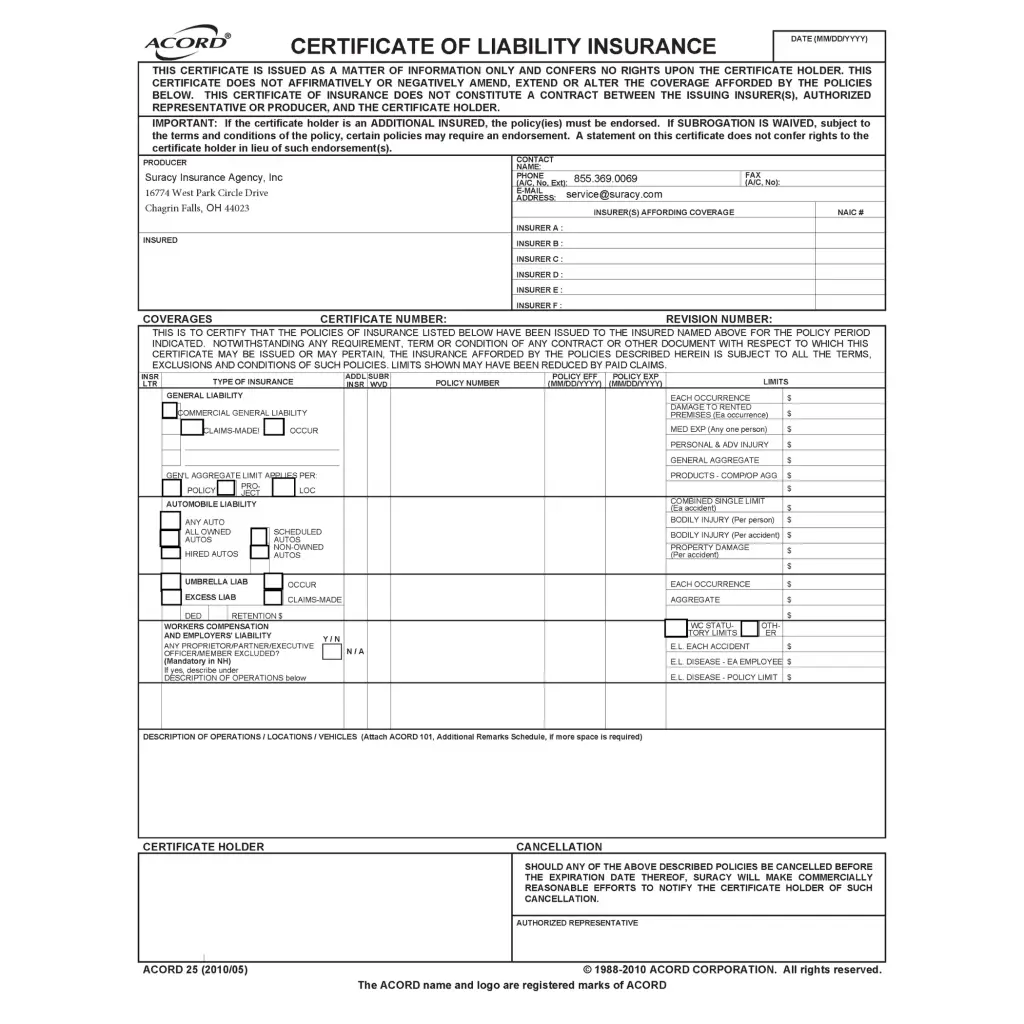
The producer, commonly referred to as an insurance agency, is the entity that represents you and has issued the certificate.
The business or person covered by the policy.
Lists the insurance policies included that your insurance producer can attest to utilizing the ACORD 25.
The letter that identifies what insurer / carrier the policy is under
The date the COI was issued.
Lists the insurance agency’s contact information:
• Contact Name
• Phone Number (FAX)
• Email Address
The carrier(s) that are responsible for affording coverage
This MUST match the Named Insured exactly as shown on the policy.
EXAMPLE:
• Policy says, “ABC Roofing LLC”. Certificate says, “ABC Roofing” WRONG!
• Adding or removing (LLC, Inc., Corp., LP) can cause a compliance rejection.
Common mistakes using the below INSTEAD of the legal insured name:
• DBA
• Trade name
• Nickname
• Parent company
This section provides details about the project or work being performed and may include required wording or references to endorsements, such as Additional Insured, Waiver of Subrogation, and Primary & Noncontributory coverage.
The person or organization that requested the COI. They are not the insured.
This section explains how cancellation notice will be provided according to the terms and conditions of the policy.
Signature of the insurance producer or authorized representative.
The maximum amount the insurance company will pay for a covered claim.
Limits may be shown per occurrence and/or in the aggregate.
Pays for small medical expenses for someone injured on the property.
Covers claims like libel, slander, copyright infringement, and other advertising injuries
A unique number assigned by the insurance company to identify a specific insurance policy. This number is used for policy verification, claims, billing, and communication with the insurer.
The date the insurance coverage begins. Coverage generally starts on this date, provided all policy requirements have been met.
The date the insurance coverage is scheduled to end. Coverage typically expires at the end of this date unless the policy is renewed or replaced.
Shows whether the insurer has agreed not to recover claim costs from another party after paying a covered loss. A checkmark indicates the waiver is in place.
Provides coverage for bodily injury, property damage and personal & advertising injury.
The incident may occur before the policy period, subject to the retroactive date, but the claim generally must be first made during the policy period for coverage to apply.
Provides coverage for accidents involving vehicles owned, used, or hired by the insured.
Shows what types of vehicles are covered by the policy:
Any Auto – all autos
All Owned Autos – vehicles the insured owns
Hired Autos – vehicles rented, leased, or borrowed
Scheduled Autos – only specifically listed vehicles
Non-Owned Autos – vehicles used for business but not owned by the insured.
Provides additional liability coverage above the limits of underlying policies.
Adds extra limits only, generally following the underlying policy’s coverage.
Covers claims that are both made and occur during the policy period (requires continuous coverage).
Covers claims that happen during the policy period, regardless of when the claim is made
Provides coverage for employees who are injured on the job and protects employers from related lawsuits.
The amount the insured pays out of pocket before the insurance company pays.
Similar to a deductible, the insured retains responsibility for this amount before coverage applies.
Maximum Employers Liability coverage for occupational disease for all employees during the policy period.
Maximum Employers Liability coverage for occupational disease for one employee.
Maximum Employers Liability coverage for bodily injury from one workplace accident.
Maximum the policy pays for bodily injury and property damage combined per accident.