
What is an Additional Insured?
Made Simple.
Learn what an Additional Insured is, why customers request one, and how to add one to your policy—all in one place.
What is an Additional Insured?
An Additional Insured is a person or company that is added to your insurance policy for protection related to the work you perform for them.
If you’re working on someone else’s property or under a contract, they may ask to be listed as an Additional Insured before work begins.
Why Am I Being Asked for This?
Many lanlords, property managers, general contractors, and businesses require contractors to add them as an Additional Insured. This helps protect them if a claim arises from the work you're performing. It is a very common requirement in the construction, home services, and contracting industries.
Common Examples
You might need an Additional Insured when working for:
• Landlords
• General contractors
• Property management companies
• Commercial property owners
• HOAs
• Municipalities or government agencies
What Is the Difference Between a Named Insured and an Additional Insured?
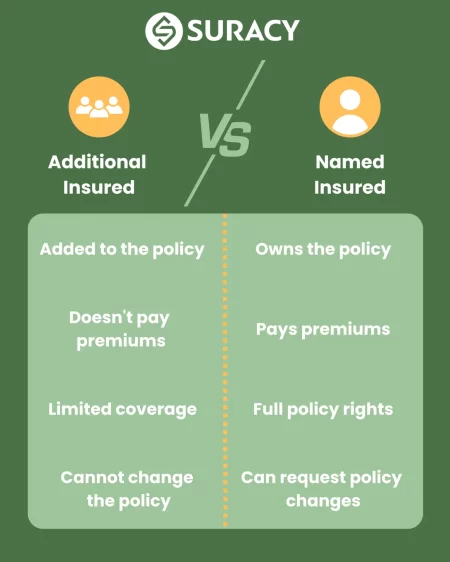
Named Insured and Additional Insured are two insurance terms that are often confused, but they have very different roles. A Named Insured owns the insurance policy, while an Additional Insured is added for certain liability protection related to the work being performed. The infographic below provides a quick side-by-side comparison to help you understand the key differences.
Tip: If someone asks to be listed as an Additional Insured, they are not becoming the owner of your policy. They are simply receiving certain liability protection related to your work.
Need Some Examples? Sure.
Landlord (Additional Insured) & Tenant (Policyholder)
• Event 1: A customer slips on a wet floor inside the tenant’s rented retail shop.
Coverage: Covered. The injury happened within the tenant’s daily business operations. The tenant’s policy will defend the landlord and pay damages.
• Event 2: A loose roof tile falls off the building exterior and hits a pedestrian on the sidewalk.
Coverage: Not covered. Exterior structural maintenance is the landlord’s independent responsibility. The landlord’s own insurance must handle this.
• Event 3: A fire starts due to faulty wiring installed by the tenant for their specific equipment.
Coverage: Covered. The property damage arose directly from the tenant’s occupancy and alterations.
General Contractor (Additional Insured) & Subcontractor (Policyholder)
• Event 1: A subcontractor’s plumber forgets to tighten a pipe, causing a massive leak that damages the drywall.
Coverage: Covered. The damage was caused directly by the subcontractor’s work. The general contractor is protected from resulting lawsuits.
• Event 2: A general contractor’s own supervisor drops a heavy tool from a scaffolding, injuring a passerby.
Coverage: Not covered. The accident was caused solely by the general contractor’s employee. It is completely unrelated to the subcontractor’s work.
• Event 3: A delivery driver trips over debris left in a walkway jointly used by the subcontractor and general contractor.
Coverage: Partially covered / Shared. Coverage depends on the percentage of fault. The subcontractor’s policy will defend the general contractor to the extent that the subcontractor’s operations contributed to the mess.
Manufacturer (Policyholder) & Vendor/Retailer (Additional Insured)
• Event 1: A consumer buys a blender from a retail store, and the blade flies off during normal use, causing an injury.
Coverage: Covered. This is a strict product defect originating from the manufacturer. The vendor is fully protected under the manufacturer’s product liability policy.
• Event 2: A retail store employee drops the blender while shelving it, cracking the base, and then sells it to a customer who gets hurt.
Coverage: Not covered. The injury was caused by the retailer’s own negligence and improper handling, not a manufacturing defect.
• Event 3: The retailer alters the blender’s wiring to display it as a working floor model, causing an electrical spark that burns a customer.
Coverage: Not covered. The retailer modified the product independently. The manufacturer’s policy will not cover claims resulting from vendor alterations.
What Information Do I Need?
To add an Additional Insured, you’ll typically need:
• The company or person’s legal name
• Their mailing address
• (Sometimes) specific wording requested in the contract
Example:
ABC Property Management LLC
123 Main St.
Cleveland, OH 44115
What happens after I submit?
1) We receive your request.
2) Your insurance provider adds the Additional Insured.
3) An updated Certificate of Insurance (COI) is issued.
4) We send your updated COI back as quickly as possible, helping you meet your customer’s requirements and keep your project moving.
Good To Know
An Additional Insured is not the same as a Named Insured.
A Named Insured owns the insurance policy and pays the premiums. An Additional Insured is simply added to the policy for certain liability protection related to the work being performed.
Being listed as a Certificate Holder does not make you an Additional Insured.
A Certificate Holder only receives proof of insurance. To receive liability protection, the party must be specifically added as an Additional Insured by endorsement.
Not every job requires an Additional Insured.
Additional Insured requests are common for contractors working with homeowners, property managers, general contractors, and commercial clients. Always review your contract to determine what's required.
Adding an Additional Insured usually doesn't require a new policy.
In most cases, your insurance carrier simply issues an endorsement and updates your Certificate of Insurance (COI).
Need Help?
Not sure who should be listed as an Additional Insured or what information is required?
Our team is here to help. We will review your request, make sure all the necessary details are included, and get your updated Certificate of Insurance (COI) issued as quickly as possible.
Ready to Add an Additional Insured?
If your customer, general contractor, or property manager requires Additional Insured status, contact your insurance agent, Suracy Insurance Agency. We will add the endorsement to your policy and issue an updated Certificate of Insurance (COI).
Need help understanding what’s required?
Our team is happy to answer your questions and point you in the right direction.
Frequently Asked Questions
Yes. You can add multiple Additional Insureds to a policy. In some cases, a Blanket Additional Insured endorsement may be needed to provide coverage for multiple Additional Insureds.
An Additional Insured is typically included for the entire policy period and will generally remain on the policy when it renews, unless a change or removal is requested.
An Additional Insured is typically required to help protect another person or organization from certain liability arising from the work or services performed by the policyholder.
Important: This material is provided for informational and educational purposes only. Insurance needs, coverage types, and coverage amounts vary based on specific circumstances. Before making any insurance decision, consult with a licensed insurance professional to determine the coverage that is appropriate for your specific needs. To learn more, contact info@suracy.com to connect with a qualified Suracy Insurance Agency professional.