
What Is Each Occurrence?
Made Simple.
Understand the Each Occurrence limit, how it protects your business, and why it’s one of the most commonly required insurance limits on a Certificate of Insurance.
What is "Each Occurrence"?
Each Occurrence is the maximum amount the insurance company will pay for a single claim or incident all covered bodily injury and property damage arising out of one single occurrence (accident or event), regardless of how many people are injured or how many claims result from that occurrence.
Think of it as the maximum payout for ONE accident.
EXAMPLE
General Liability Each Occurrence Limit: $1,000,000.
A contractor accidentally ruptures a water line while working in a building which causes:
• $400,000 in property damage
• $250,000 in business interruption claims from tenants
• $150,000 in bodily injury claims
If all of the damages were $1,300,000, the insurer would pay no more than the $1,000,000 Each Occurrence Limit, and the insured could be responsible for the remaining $300,000 unless another policy, such as an umbrella policy, provides additional coverage.
KEY POINTS:
• Applies to one covered occurrence
• Includes covered bodily injury, property damage and in some cases associated legal defense costs depending on how the policy is structured
• It is not the total amount available for the entire policy year, that is generally governed by the General Aggregate Limit
Why is it Important?
Many companies require contractors to carry a minimum Each Occurrence limit before allowing them to work.
A higher limit provides:
• More protection for a single accident
• Greater financial security
• Compliance with customer or contract requirements
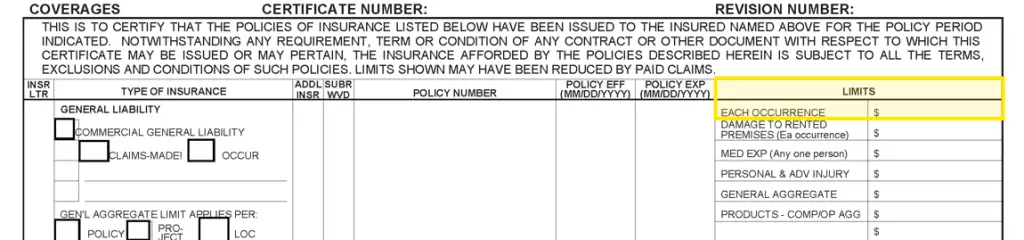
Where Can I Find It?
On your Certificate of Insurance (COI), look under Commercial General Liability.
It will typically look like:
What's the Difference Between Each Occurrence and General Aggregate?
These two limits are often confused.
• Maximum paid for one claim or accident
• Resets for each separate covered occurrence (up to policy terms)
• Helps protect your business from large, individual liability claims.
• Commonly required by customers and contracts.
• Example: $1,000,000 per covered occurrence.
Compare
• Maximum paid for all claims combined during the policy period
• Total amount available before the policy limit is exhausted
• Decreases as covered claims are paid.
• Once the aggregate limit is reached, additional covered claims may not be covered.
• At least be equivalent to the Each Occurrence limit.
• Example: $2,000,000 total for the policy period.
Quick Tip
Each Occurrence = one covered claim.
General Aggregate = all covered claims during the policy period.
Frequently Asked Questions
Yes. Your Each Occurrence limit can be higher than your customer’s requirement. The coverage is designed to protect your business against liability, so you may choose a higher limit based on your coverage needs.
Typically, yes. Increasing your Each Occurrence limit may result in a higher insurance premium because you are increasing the amount of coverage provided by your policy.
It depends on your insurance carrier’s guidelines. Some carriers may allow you to change your Each Occurrence limit after the policy starts, while others may have specific restrictions or requirements.
Typically, if your Each Occurrence limit does not meet the required amount, you may not be able to perform the work until your coverage meets the requirement.
Your insurance agent can help you review and update your insurance limits to meet the required coverage.
Important: This material is provided for informational and educational purposes only. Insurance needs, coverage types, and coverage amounts vary based on specific circumstances. Before making any insurance decision, consult with a licensed insurance professional to determine the coverage that is appropriate for your specific needs. To learn more, contact info@suracy.com to connect with a qualified Suracy Insurance Agency professional.